
What Is Agentic AI? A Clear Definition for Salesforce and HubSpot Teams
A practitioner definition of agentic AI, a test to spot a real agent vs. a rebranded chatbot, and what to ask before buying anything agentic.
AI Agents ·
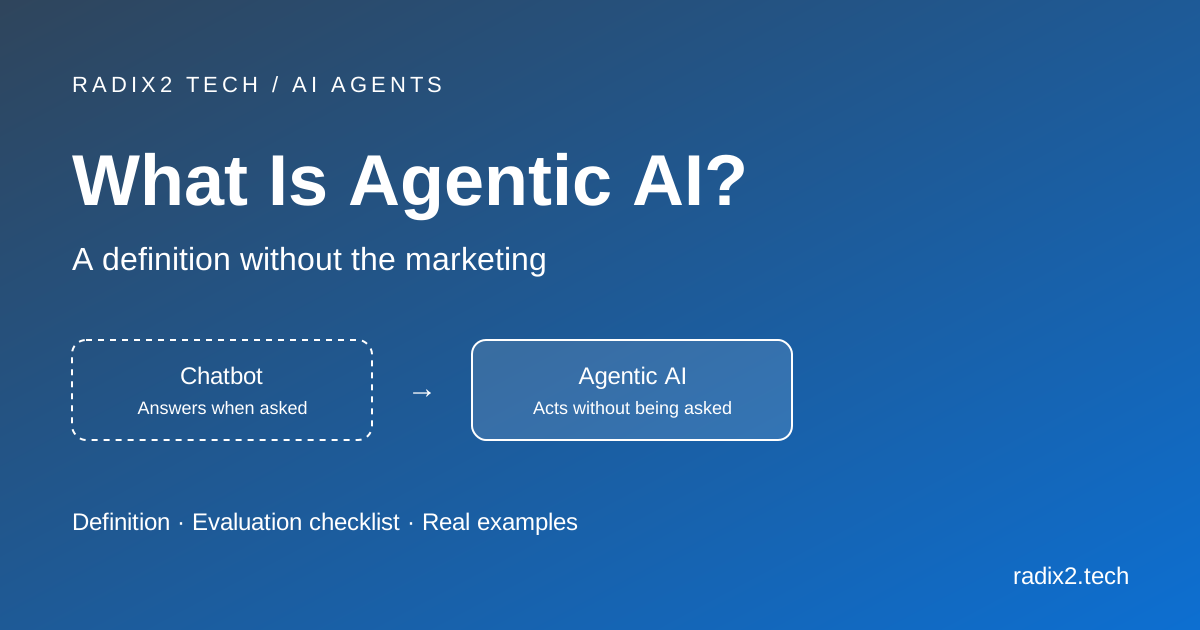
Every vendor at Dreamforce 2026 called their product "agentic AI." Salesforce built the entire conference around it — seven new pre-built agents, a keynote on the "Agentic Enterprise," a new long-horizon runtime. That is a lot of marketing pressure to understand a term fast, and most of what gets written about it either oversimplifies it into "smart chatbot" or buries it in vendor jargon that tells you nothing you can act on.
Here is the definition we actually use when scoping a real implementation, the test we run to tell a genuine agent from a rebranded chatbot, and what to ask before you buy anything with "agentic" in the name.
What Is Agentic AI, Actually?
Agentic AI is software that perceives the current state of your data, decides what to do about it, and acts — without a person prompting each individual step. Three things have to be true at once for something to actually qualify:
- It perceives real, current data — not a static prompt someone typed in, but a live look at your actual records.
- It decides on its own — evaluating the situation and choosing an action, not just generating a suggestion for a human to approve every time.
- It acts through a real tool — creating a task, updating a record, sending a draft — not just producing text in a chat window that someone has to copy elsewhere.
Miss any one of the three and what you have is a chatbot with a nicer interface, not an agent.
The Simple Test: Agentic AI vs. a Chatbot With Extra Steps
Most of the confusion around this term comes from products that pass one or two of the three criteria above and get marketed as fully agentic anyway. Here is the distinction that actually matters:
| A Chatbot | Agentic AI |
|---|---|
| Answers when you ask it something. | Notices something on its own and acts without being asked. |
| Needs a new prompt for every step. | Pursues a multi-step goal across a single run, or across days. |
| Forgets everything once the chat ends. | Retains memory across a session, or across days and weeks. |
| Can only read and describe your data. | Can create or update real records through a live connection. |
| No concept of your permission model. | Inherits your existing field-level security and sharing rules automatically. |
Where This Shows Up in Salesforce and HubSpot Right Now
This is not a hypothetical category — real, working examples exist today, and two are worth knowing by name:
Salesforce Agentforce
Salesforce's own implementation: seven pre-built, named agents (Casey for customer service, Paige for IT/HR, Carter for e-commerce, Hunter for outbound sales, Marshall for supply chain, Piper for lead generation, Fin for complex customer experience workflows), each running natively on your Customer 360 data. The 2026 addition is a long-horizon runtime — memory preservation across sessions, durable execution over days or weeks, and dynamic steering based on feedback — which is what actually separates this from a scheduled report.
Grok Bot's Salesforce and HubSpot Connectors
xAI shipped official Salesforce and HubSpot connectors for Grok Bot in September 2026 — real-time queries against your actual data model, respecting your existing field-level security automatically, with nothing copied to xAI's servers. It does not match Agentforce's native long-horizon runtime, but it is a real, live-connected agent, not a browser workaround or a demo against sample data.
How to Evaluate an "Agentic AI" Claim Before You Buy
In 38 implementations, the vendor pitches that fall apart fastest under a real question are the ones leaning hardest on the word "agentic" without being able to answer these five things:
- What can it do without me prompting it? If the honest answer is "nothing, you have to ask it every time," it is a chatbot.
- What data can it write, not just read? Read-only agents can still be useful, but they are not doing the work — they are describing it.
- What happens when it makes a wrong call? A vendor with a real answer will describe specific guardrails — what the agent can decide alone versus what always requires a human. A vendor without one will talk about "accuracy" in the abstract.
- Does it retain memory across sessions or days? A single request-response exchange, no matter how smart, is not a long-horizon agent.
- Does it inherit your existing permissions automatically? If a user cannot see a field in your CRM, the agent should not be able to see it either — without you configuring that separately.
Is Agentic AI Worth It for a Team Your Size?
Not always, and team size is the wrong variable to check first. The real question is whether your underlying data is clean and consistent enough for an agent to act on reliably — a 10-person team with an organized CRM is often a better candidate than a 500-person team with years of undocumented customization sitting underneath it. An agent given autonomy on messy data does not fix the mess. It acts on it, confidently, and gets it wrong at scale.
Frequently Asked Questions
What is agentic AI in simple terms?
Agentic AI is software that perceives your live data, decides what to do about it, and acts on its own — drafting a follow-up, updating a record, flagging a stale deal — without a person prompting each step. A chatbot answers when asked; an agent acts without being asked.
Is agentic AI the same as Salesforce Agentforce?
Agentforce is Salesforce's specific product implementation of agentic AI — seven pre-built named agents running on Customer 360 with a dedicated long-horizon runtime. Agentic AI is the broader category; Agentforce, Grok's connected agents, and custom-built agents are all specific ways to get there.
How is agentic AI different from automation or workflow rules?
Fixed workflow rules (Salesforce Flow, HubSpot Workflows) run deterministic "if X then Y" logic — reliable, but brittle the moment a situation needs judgment. Agentic AI adds a reasoning layer that can handle cases a fixed rule cannot anticipate, while ideally still respecting hard guardrails for the parts that should never vary.
Can agentic AI make mistakes, and who is responsible if it does?
Yes — any system that acts autonomously can act on a wrong assumption. Responsible agentic AI deployments define explicit guardrails (what the agent can decide alone versus what needs human approval) before going live, and stage rollouts to a small group first so mistakes are caught early. If a vendor cannot explain their guardrail model, that is a real gap, not a detail.
Do I need agentic AI if I'm a small business?
Team size matters less than whether your underlying data is clean enough for an agent to act on reliably. A 10-person team with an organized CRM is often a better candidate than a 500-person team with years of undocumented customization sitting underneath it.
What should I ask a vendor claiming their product is "agentic AI"?
Ask what it can do without you prompting it, what data it can write (not just read), what happens when it makes a wrong call, whether it retains memory across sessions or days, and whether it inherits your existing permission model automatically. A real agent has clear answers to all five; a rebranded chatbot usually stalls on the first two.
What is a "long-horizon" agent?
A long-horizon agent pursues a goal across days or weeks, not just a single request-response exchange — it needs durable memory of what it has already tried, and a way to adapt when a human gives it feedback mid-run. Salesforce's Agentforce runtime is a current example built specifically for this.
Where can I see agentic AI actually working, not just marketed?
Look for a live, real-time connection to your specific CRM data, not a demo against sample data. Both Salesforce Agentforce and Grok's official Salesforce and HubSpot connectors are examples of agents that read and act on your actual records today, respecting your existing field-level security automatically.