
What Is Claudeforce? How the Salesforce + Anthropic Partnership Will Transform Your Business
Claudeforce embeds Claude inside Salesforce and Slack. Here's what it actually does, 5 real changes for sales teams, and 3 things to fix before you switch.
Salesforce AI ·
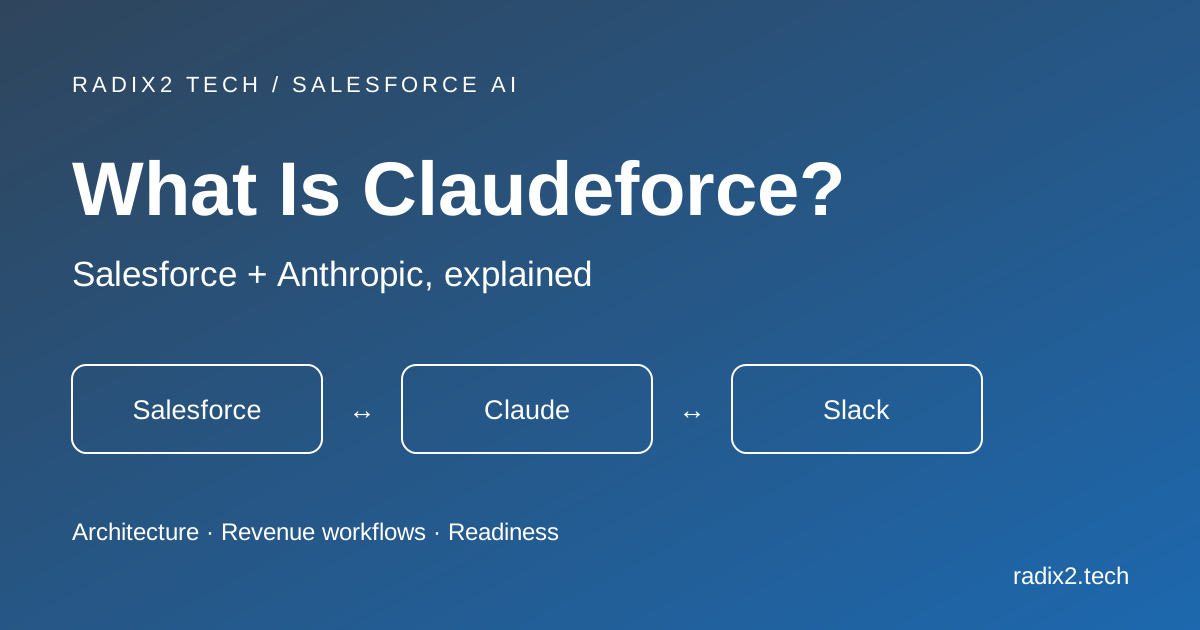
For years, enterprise AI adoption has suffered from a fundamental disconnect: reasoning happens in one tab, while business data lives in another. Sales reps, account managers, and executives frequently bounce between conversational AI interfaces and complex CRM dashboards to summarize calls, review pipeline health, and update account records.
Announced as an expanded strategic alliance between Salesforce and Anthropic, Claudeforce bridges that gap. It embeds Claude’s reasoning directly into Salesforce and brings live, governed CRM data straight into the Claude interface.
Read the official Salesforce announcement.
Here is an in-depth breakdown of what Claudeforce is, how its architecture works, and the tangible business advantages it delivers to modern revenue organizations.
What Is Claudeforce?
Claudeforce is the umbrella name for the bi-directional enterprise integration between Anthropic’s Claude models and Salesforce’s ecosystem, spanning Salesforce CRM, Agentforce, and Slack.
Rather than requiring development teams to build custom API wrappers or manage complex Model Context Protocol (MCP) servers for every individual user, Claudeforce operates as a native, governed enterprise bridge:
- Salesforce in Claude: A native plugin inside the Claude workspace packaged with 37 prebuilt sales skills, including automated deal-health diagnostics, pre-call briefing generation, and conversational pipeline updates.
- Claude in Agentforce: Claude powers Salesforce’s Atlas Reasoning Engine—the core planning layer that enables autonomous Agentforce agents to evaluate context and execute multi-step workflows.
- Claude in Slack: Serves as the native intelligence layer for cross-channel search, conversational document summarization, and team updates across connected Salesforce and Tableau data.
The Core Difference: Skills vs. Raw Tools
A standard API or DIY connector gives an LLM raw database access and expects the user to engineer the prompt. If a rep asks a generic model to “check deal health,” the output will vary wildly depending on how the prompt was phrased.
Claudeforce solves this with packaged, opinionated business skills:
| Traditional CRM + AI | Claudeforce Integration |
|---|---|
| Reps copy/paste notes between tabs. | Live CRM read/write directly inside Claude chat. |
| Requires manual SOQL or API token management per seat. | Managed centrally by admins with zero individual token setup. |
| Generic LLMs guess which custom fields represent true deal health. | 37 purpose-built revenue skills interpret company-specific sales stages. |
| Data leaves corporate boundaries to public LLM endpoints. | Inference runs securely inside the Salesforce Trust Boundary via Amazon Bedrock. |
5 Ways Claudeforce Will Improve Your Business
1. Eliminating Administrative Drag
Sales reps lose valuable selling time to administrative overhead— logging activities, digging through historical account threads, and updating opportunity stages.
With Claudeforce, prep work becomes instantaneous. Asking “Prepare my briefing for the Acme renewal call at 2 PM”prompts Claude to pull recent cases, past email summaries, executive changes, and quote statuses into a consolidated briefing card in seconds.
2. Eliminating Deal Bias in Forecast Calls
Pipeline reviews often rely on subjective rep optimism. Claudeforce evaluates opportunity velocity against historical org benchmarks:
- Flags single-threaded deals lacking executive touchpoints.
- Detects when a deal's close date has slipped multiple times without logged activity.
- Highlights stalled procurement or security reviews before they compromise quarter-end forecasts.
3. Native Natural-Language CRM Updates
After completing a call, reps can paste bulleted notes or dictate a voice memo into Claude. Claudeforce parses out next steps, identifies budget shifts, and automatically updates the respective Opportunity, Contact, and Task fields in Salesforce—all while enforcing validation rules.
4. Reliable Enterprise Governance & Role-Based Security
The biggest hurdle to deploying AI across large revenue teams is access control. Claudeforce inherits Salesforce’s existing Role Hierarchy, Object-Level Security (OLS), and Field-Level Security (FLS):
- If an Account Executive cannot view ARR or executive salary fields in Salesforce, Claude cannot surface that data in chat.
- For regulated industries (FinTech, Healthcare, Public Sector), the integration runs inside Salesforce's virtual private cloud via Amazon Bedrock, ensuring customer data is never used to train foundational models.
5. Unified Context Across Salesforce and Slack
Because Slack, Salesforce CRM, and Tableau share an underlying data fabric, Claudeforce allows cross-functional collaboration without data silos. Revenue, customer success, and product teams can interrogate live account data and trigger workflows directly within team channels.
What to Fix Before You Switch
Claudeforce is powerful, but it isn't magic—it relies on what’s already in your CRM. Three things to sort out before launch:
- Merge duplicates: If your team struggles to find the master account, an AI agent will too. Clean up duplicate records so answers stay accurate.
- Lock down permissions: AI makes asking for data easy. Run a quick security audit to ensure sensitive fields stay restricted to the right eyes.
- Ditch rogue spreadsheets: Move offline approval rules and discount matrices into Salesforce so Claude can actually factor them into deal reviews.
Conclusion
Claudeforce represents the evolution of CRM software from a passive database into an action-oriented intelligence partner. By pairing Anthropic's frontier reasoning with Salesforce’s enterprise data and permission structures, businesses can automate operational friction and free their revenue teams to focus on customer relationships.